
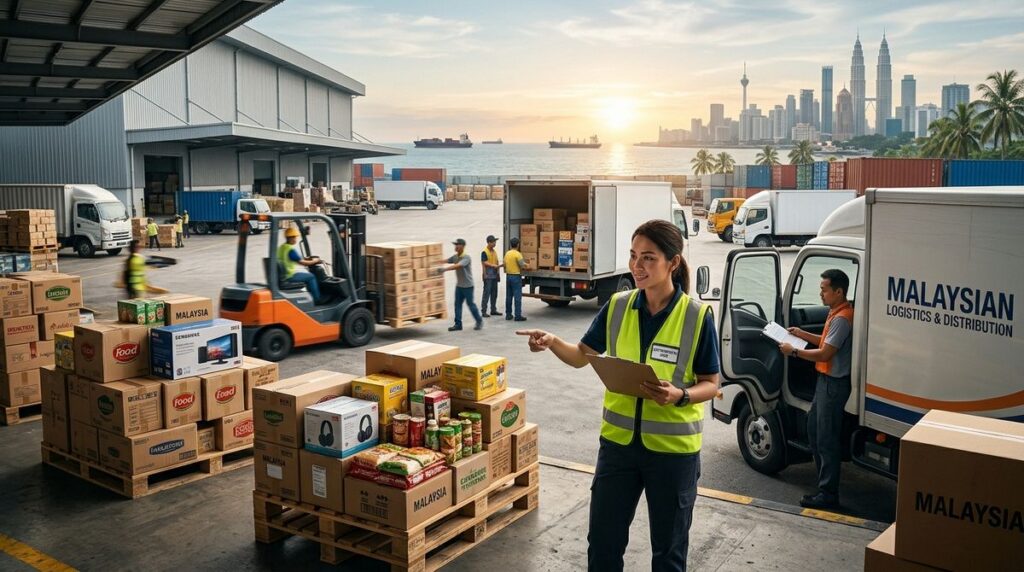
In Malaysia’s USD 86.5 billion retail market, the distributor role is frequently misunderstood, underestimated, and poorly specified at the point of appointment. Brand owners entering Malaysia for the first time, or those reviewing an underperforming distributor relationship, benefit from a clear-eyed account of what a distributor actually does, what the Malaysian retail landscape demands, and how to tell a high-performing distributor from one that will plateau.
What a distributor actually does in the malaysian market
A distributor is a business-to-business intermediary that purchases goods from a brand or manufacturer, holds physical inventory, and sells and delivers those goods to retailers. In Malaysia, that means provision shops (small independent grocery stores, often Chinese-owned), mini markets, pharmacies, baby stores, supermarkets, and specialty retail. The distributor takes title to the goods, manages working capital, and bears the operational cost of getting products onto shelves.
This distinguishes distributors from agents, who represent brands commercially but do not take stock ownership, and from wholesalers, who typically sell in bulk to other traders rather than calling on retail accounts directly. The distributor is the party responsible for physical market execution, not just order facilitation.
In a retail market forecast to reach USD 110.5 billion by 2031 at a 4.1% CAGR, the distributor’s role is not a back-office function. It is the operational engine of market access.
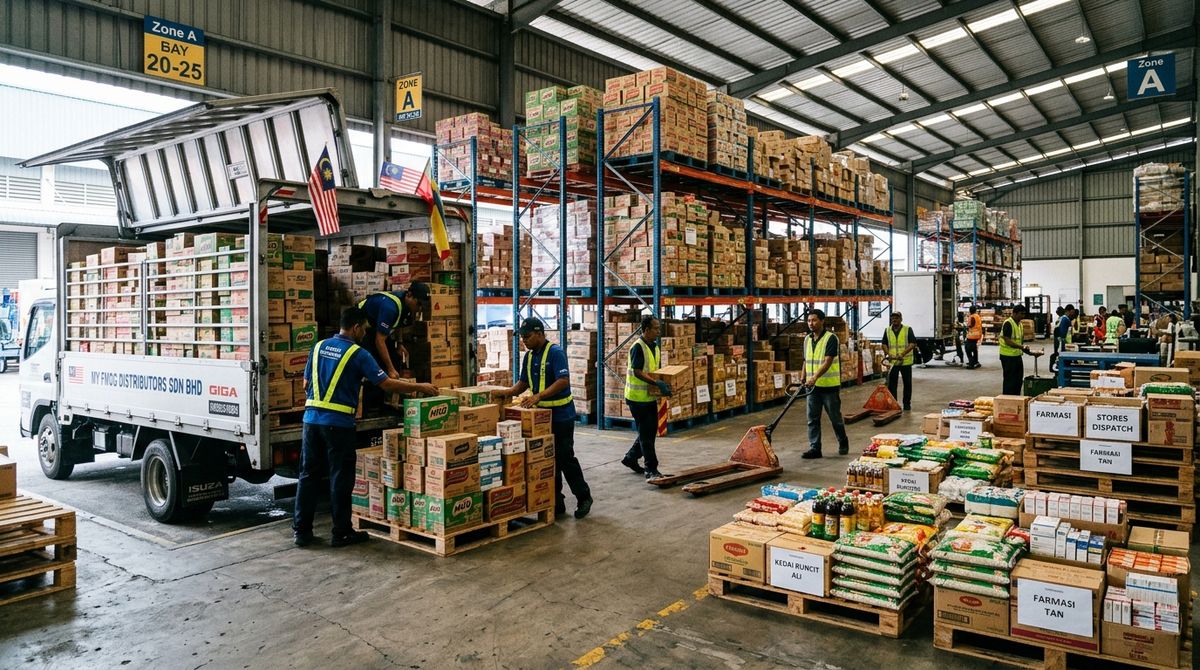
The five core functions a distributor performs
Brands evaluating distributors in Malaysia tend to focus on one or two variables, typically warehouse size or sales headcount. The more useful frame is a five-function assessment. A distributor that performs well on logistics but poorly on data reporting is a partial asset. Understanding all five functions is the starting point for a sound evaluation.
1. Physical logistics and inventory management
The logistics function covers warehousing, stock management, order fulfilment, and last-mile delivery to retail accounts. For ambient FMCG products, this means adequate warehouse space, organised pick-and-pack operations, and a reliable delivery fleet. For chilled or frozen goods, cold chain infrastructure becomes a separate requirement that many general distributors cannot meet.
The delivery cadence matters as much as the warehouse capacity. Convenience formats and neighbourhood mini markets typically receive deliveries two to three times per week, in small volumes. A distributor serving these channels must run high-frequency, low-drop routes efficiently, which demands routing discipline and a sufficient truck fleet. To illustrate the scale involved: 99 Speedmart’s Semenyih distribution centre covers 63,000 sq ft and supports 180 outlets from a single facility. That is the operational benchmark for high-frequency neighbourhood retail.
At Lim Soon Huat Group, our four distribution centres across Kepong, Sungai Buloh, and Kuantan total more than 105,000 sq ft of warehouse space, supported by a fleet of over 30 owned trucks. That infrastructure is what consistent retail replenishment actually requires.
2. Market access and channel coverage
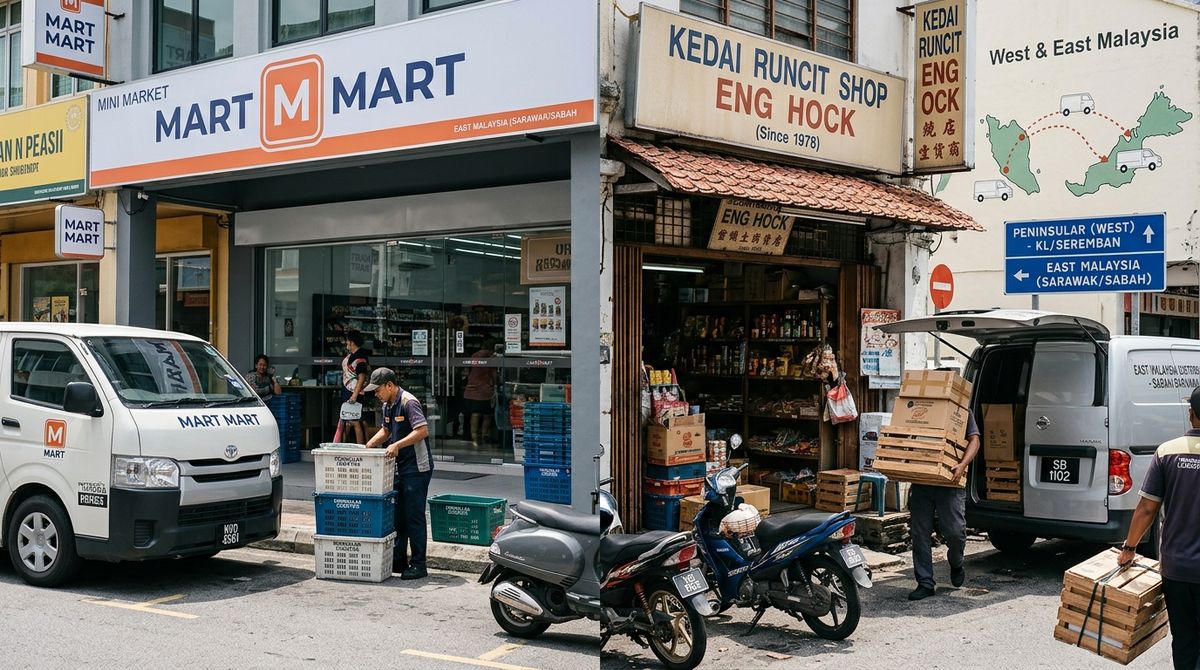
A distributor’s value to an incoming brand is directly proportional to the retail relationships it already holds. Channel coverage in Malaysia spans modern trade (supermarkets, hypermarkets, chain mini markets), general trade (independent provision shops, mini markets), pharmacy chains, baby stores, and specialty retail. Each channel has different buying processes, margin expectations, and ranging criteria.
Peninsular Malaysia accounts for 84.1% of retail market share nationally, with the Klang Valley (Kuala Lumpur and Selangor), Penang, and Johor Bahru as the three primary commercial concentrations. East Malaysia, covering Sabah, Sarawak, and cities including Kota Kinabalu, Kuching, and Bintulu, is an active expansion frontier but requires separate network planning. Distribution infrastructure there is thinner, routes are longer, and many distributors covering Peninsular Malaysia do not have genuine East Malaysia operations despite claiming national coverage.
Understanding which channels a distributor actively serves, not just nominally lists, is the first question to answer before appointment.
3. Pricing management and trade terms
Distributors sit between the brand’s ex-factory price and the shelf price seen by consumers. Managing that margin ladder, across distributor margin, retailer margin, and promotional allowances, is a commercial function that directly affects brand competitiveness on shelf.
Scale matters here. Larger distribution networks can offer retailers better trading terms through bulk purchasing efficiencies, which is precisely how chains like 99 Speedmart exert pricing influence across tens of thousands of SKUs. For brands, this means a distributor’s commercial scale affects whether a product can be priced competitively in the market, not just whether it can be delivered. Pricing management is a strategic variable, not an administrative one.
For brands weighing up the trade-offs between distributor and direct sales models, the pricing and margin dynamics of each route are worth examining in detail before committing.
4. Sales execution and merchandising
The field sales function is where distributor performance is most visible and where underperformance is most common. Sales execution covers calling on retail accounts on a defined frequency, negotiating shelf placement, managing promotional activity, and ensuring product availability at point of sale. Merchandising covers the physical execution: planogram compliance, stock rotation, display placement, and out-of-stock identification.
This function is the daily commercial contact between the brand and the trade. A distributor with strong logistics but weak field execution will warehouse products efficiently and deliver them inconsistently. The practical recommendation is to evaluate distributors on call frequency by outlet tier, planogram compliance rates, and out-of-stock incidence, not on revenue figures alone, which can mask poor outlet-level performance.
Our ALSH company (Lim Soon Huat Agency Sdn Bhd) was established in 2011 specifically to provide dedicated key account management and merchandising for multinational principals who need that separation from general distribution operations.
5. Market intelligence and reporting
The reporting function separates a strategic distributor from a transactional one. Sell-in data, that is, invoice volumes from distributor to retailer, tells a brand what has been shipped. Sell-out data tells a brand what consumers are actually buying. The gap between the two reveals whether stock is moving through retail or accumulating in the channel.
Brands without access to weekly sell-out reporting are operating on delayed signals. Distribution gaps, slow-moving SKUs, and promotional underperformance that would be visible in sell-out data may not surface in monthly sell-in invoices until inventory problems have already compounded. For a new SKU launch, this gap in information directly extends time-to-correction and reduces the ROI of launch investment.
How the malaysian retail landscape shapes distributor requirements
Malaysia’s retail structure is not uniform, and the distributor requirements it creates are not generic. Three structural realities define what a distributor must be capable of delivering.
A fragmented trade with concentrated growth at the top
Modern trade chains and independent general trade coexist and compete, often in the same neighbourhood. 99 Speedmart operates over 3,000 outlets and targets 250 new stores per year, adding approximately 1,000 more outlets over the next four years. That expansion pace puts a chain mini market within walking distance of an increasing share of Malaysian households, directly competing with independent provision shops on price and convenience.
For brands, this dual structure creates a coverage challenge. Modern trade chains are negotiated centrally, with ranging decisions made at head office level. Independent general trade, covering tens of thousands of provision shops and mini markets across Peninsular Malaysia, is called on individually by field sales teams. A distributor that serves only one of these two structures is delivering partial market access, whatever its headline outlet count suggests. For brands assessing the full scope of what a Malaysian FMCG distributor does in practice, the channel mix question is worth examining early.
Digital payments changing merchant and distributor operations
The payment infrastructure serving Malaysian retailers has changed substantially. DuitNow QR transaction volume doubled from 1.5 billion transactions in 2024 to 3 billion in 2025, with nearly 3 million merchant touchpoints registered nationally. Retail e-payment value reached RM 831 billion. The practical implication for distributors serving smaller independent merchants is straightforward: encouraging QR payment adoption lowers transaction acceptance costs for those merchants, since the zero merchant discount rate removes the fees that card payments carry. Wider payment acceptance expands each outlet’s customer reach, which benefits product offtake.
Geographic coverage as a strategic variable
Klang Valley, Penang, and Johor Bahru are mature markets with established distributor networks and dense retail infrastructure. Sabah, Sarawak, and secondary East Malaysian cities are different in character: longer supply lines, fewer distribution hubs, and in many areas, a retail structure dominated by smaller independent stores.
Brands entering Malaysia for the first time should clarify geographic scope before appointing a distributor. A claim of national coverage requires scrutiny. The question to ask is not whether a distributor nominally covers East Malaysia, but whether it has owned infrastructure or verified managed-distributor partnerships in those states, and what service frequency those partnerships deliver.
What separates a high-performing distributor from an average one
Based on observed practice across FMCG categories in Malaysia, three factors consistently differentiate distributors that drive brand growth from those that plateau after initial ranging.
Coverage depth, not just headline numbers
An outlet count is not a measure of active coverage. The meaningful metrics are active account penetration (what share of the outlet universe is called on regularly), call frequency by channel, and out-of-stock rates at point of sale. A distributor serving 8,000 accounts monthly is delivering more than one claiming 12,000 accounts visited quarterly.
The recommendation is to request outlet universe data broken down by channel and region, then verify the ratio of active to dormant accounts before signing a distribution agreement.
Data quality and reporting discipline
High-performing distributors provide sell-out data as a standard part of the principal relationship, not as a negotiated concession. The field data shows that brands with access to weekly sell-out reporting identify distribution gaps and promotional underperformance weeks earlier than those relying on monthly sell-in invoices. For a new market entrant, that speed of feedback directly affects whether launch investment is redirected in time to matter.
Before appointing a distributor, a structured due diligence process should include a direct request for sample reporting outputs, not a description of reporting capabilities.
Alignment on investment and brand building
Distributors that treat trade spend as a shared investment, with agreed activation plans, measurable targets, and joint business planning, produce stronger retail outcomes than those operating on a pure margin model. The practical test is whether a prospective distributor can present a structured joint business planning process, with named KPIs and review cadences, before appointment rather than after.
How to evaluate a distributor before appointing one
Distributor selection in Malaysia warrants the same rigour as a market entry strategy. The evaluation should cover four dimensions.
The first is channel and geographic fit: does the distributor’s active coverage match the channels and regions the brand needs to reach in year one, not just year three?
The second is principal portfolio and conflict: a distributor carrying competing brands in the same category is a structural conflict of interest. If a sales rep is calling on the same outlet with two competing shampoo brands, one of them will receive less attention. This is not a minor risk; it is a predictable outcome.
The third is warehouse and logistics infrastructure: physical capacity, cold chain where relevant, delivery fleet ownership versus third-party reliance, and demonstrated replenishment frequency for similar-sized accounts.
The fourth is reporting and data systems: what sell-out data does the distributor provide, at what frequency, and in what format? Brands that accept vague answers at this stage will find themselves without usable market intelligence six months into the relationship.
For a structured approach to this process, the checks worth completing before signing a distribution agreement cover each of these dimensions in detail.
Common misconceptions about the distributor role in malaysia
Three recurring misconceptions cause brands to appoint the wrong distributor or manage the relationship poorly once appointed.
The first is that a large sales force guarantees wide coverage. Headcount does not equal active account reach. A team of 60 sales reps calling on 200 accounts per rep per month is more productive than a team of 100 reps calling on 80 accounts per rep. The metric that matters is active call coverage, not payroll size.
The second is that the distributor owns the brand’s market position. Distributors execute in trade. Brand owners retain responsibility for pricing strategy, brand standards, packaging compliance, and consumer demand generation. A distributor cannot build brand equity; it can only distribute a brand that has been built. Marketing investment, digital presence, and consumer pull remain the principal’s responsibility throughout the distribution relationship.
The third, and most consequential, is that appointing a distributor ends the work of market entry. Brands that treat distributor appointment as the finish line, rather than the starting line, consistently underperform against launch targets. The relationship requires active management: monthly performance reviews, joint planning on trade activation, and clear consequence frameworks for missed KPIs. Passive principals produce passive distributors.
The strategic recommendation
In Malaysia’s expanding, fragmented retail market, the right distributor is a growth asset. The selection decision deserves the same rigour applied to a market entry strategy, not the speed of a vendor shortlist.
Based on observed outcomes across FMCG categories, brands that invest in distributor due diligence, set clear KPIs from month one, and maintain active principal engagement achieve retail penetration targets faster and sustain distribution gains longer than those that do not. The recommendation is to treat distributor performance review as a quarterly commercial priority, with structured joint business planning and defined escalation processes, not an annual administrative exercise.
Food, beverage, and personal care account for the dominant share of Malaysian retail volume. The distributors serving these categories well are those with infrastructure depth, active account coverage, and reporting discipline. Those are the variables worth assessing before appointment.
If the assessment process raises questions about how to structure a distributor partnership for the Malaysian market, we are available to discuss the specifics at /partner-with-us.