
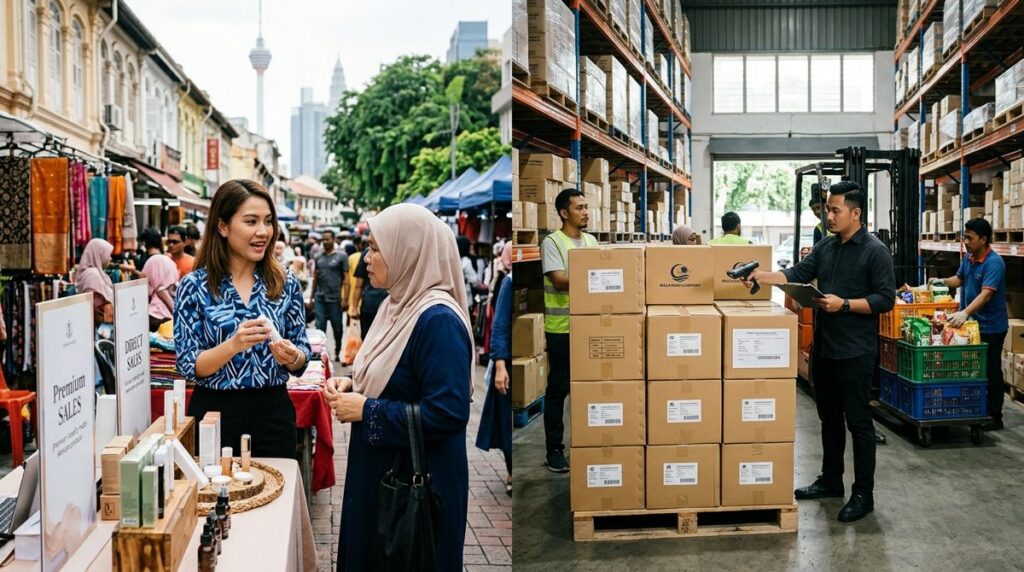
Channel choice in Malaysia is not a tactical detail, it is the decision that sets the trajectory of a brand’s revenue, margin structure, and market presence for years. The distributor vs direct sales question sits at the centre of every market entry conversation we have with international brand owners, and the answer is rarely simple. This article evaluates both models across five dimensions: market coverage, cost structure, brand control, data access, and regulatory complexity. The recommendation that emerges from that analysis may not be what most brand owners expect.
What each model actually means in the malaysian market
Before comparing the two models, it is worth being precise about what each actually involves in the Malaysian context. “Direct sales” is frequently misread as direct-to-consumer e-commerce. That is one form of it, but it is not the whole picture. Similarly, “distributor” is used loosely to describe arrangements that range from a full-service national partner to a regional van-seller with 200 accounts. The distinction matters because the commercial implications of each are substantially different.
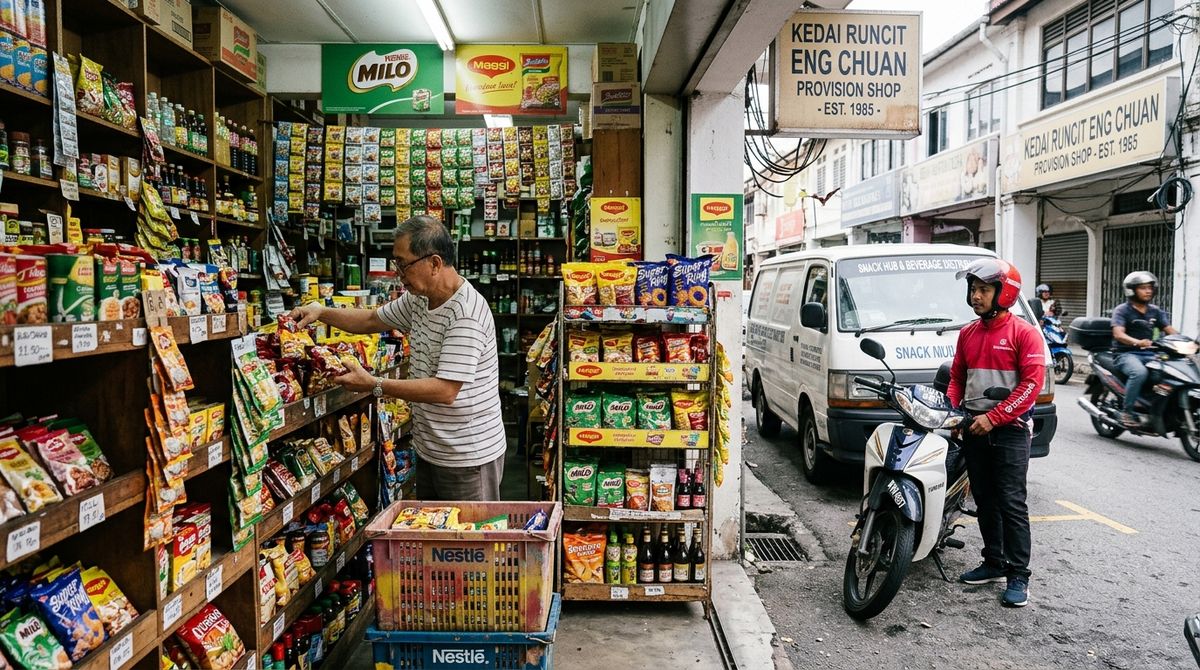
Malaysia’s retail landscape is fragmented in ways that are not obvious to brand owners entering from more consolidated markets. The trade structure spans modern trade (hypermarkets, supermarkets, and pharmacies such as Guardian and Watsons), mini markets (small urban convenience stores, often independent), provision shops (also called sundry shops, family-run general stores that remain a primary shopping point in suburban and semi-rural areas), Chinese medical halls, and independent pharmacies. General trade refers to all independent retail outside the major chains. Modern trade refers to the organised chains. Both matter.
How distributor models operate in malaysia
In a distributor-led model, the brand owner (the principal) appoints a local company to manage trade relationships, logistics, retailer credit, and field sales on the principal’s behalf. The distributor purchases stock from the principal at an agreed price, then resells to retailers at a margin. The principal does not carry accounts receivable risk with individual retailers, the distributor does.
Malaysian distributors range from national operators covering all channels across Peninsular Malaysia, Sabah, and Sarawak, to regional specialists focused on a single geography or channel type. East Malaysia (Sabah and Sarawak) is a structurally distinct market with its own logistics requirements and retailer relationships. Most direct sales operations built by international principals struggle to serve East Malaysia at all, which is why understanding what a Malaysian FMCG distributor actually does is the right starting point before making any channel decision.
How direct sales models operate in malaysia
Direct sales in the Malaysian FMCG context takes two forms. The first is a principal’s own in-country sales team that calls on retailers, negotiates trade terms, manages promotional execution, and collects payment directly. The second is digital-direct: selling through TikTok Shop, Shopee, or Lazada without touching the traditional trade channel at all.
Both are legitimate models. The global direct selling market is projected to grow from USD 269 billion in 2025 to USD 432 billion by 2033, a 6.08% CAGR, and Malaysia’s digital commerce growth is a meaningful part of that trajectory. TikTok Shop in particular has changed the addressable market for direct-to-consumer brands in categories like health and wellness, personal care, and baby care. That said, digital-direct and trade-direct are not interchangeable, and neither replaces the breadth that a qualified distributor provides across general trade.
Market coverage and speed-to-shelf
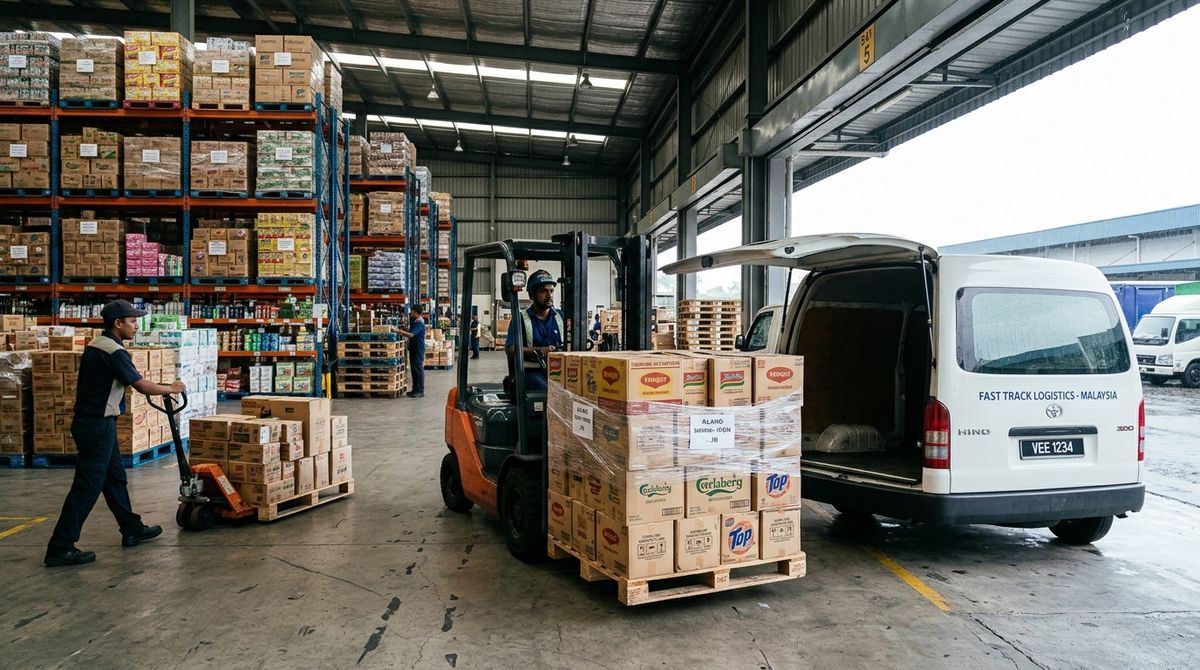
This is where the distributor model wins decisively for most entering brands. A qualified Malaysian distributor brings existing credit relationships with retailers, an active field force, and logistics infrastructure that takes years and significant capital to replicate. Based on our experience placing brands across 12,000+ retail doors, a distributor with established trade relationships compresses time-to-shelf by four to six months compared to a greenfield direct sales operation.
That compression matters because shelf placement is not just a distribution metric, it is a revenue event. Every month a product is not on-shelf in targeted outlets is revenue that cannot be recovered.
Distributor reach across malaysian trade channels
A well-networked distributor covers channels that most direct sales teams cannot reach efficiently: provision shops in Klang Valley suburbs, mini markets in secondary towns, independent Chinese medical halls, rural pharmacies, and East Malaysian trade. These are not marginal outlets. General trade accounts for a substantial share of FMCG volume in Malaysia, particularly in personal care, household products, and food and beverage.
The logistics dimension is equally important. Warehousing in Malaysia requires bonded facilities if the brand is importing, plus cold-chain capability for certain categories. Lim Soon Huat Group operates four distribution centres totalling over 105,000 sq ft across Kepong, Sungai Buloh, and Kuantan, with a managed partner network covering the rest of Peninsular Malaysia. That infrastructure does not appear on a P&L line for a principal working through a distributor, it is absorbed into the distributor’s margin structure.
Direct sales coverage limitations and workarounds
A direct sales team can cover key accounts, hypermarket groups, pharmacy chains, and major modern trade operators, with reasonable efficiency. These are structured buyers with central purchasing, defined ranging processes, and predictable promotional calendars. For premium brands competing in a small number of doors, a direct team is entirely workable.
The structural ceiling appears when a brand needs breadth. Reaching 2,000 provision shops across Selangor and Kuala Lumpur alone requires daily route-to-market coverage, credit management with hundreds of individual retailers, and a returns and credit note process that consumes significant back-office capacity. The capital and headcount required to replicate what a distributor does across general trade is not justified for most entering brands until volume is well established.
Margin structure and cost of sale
The comparison most brand owners reach for first is gross margin: distributor margin versus the loaded cost of a direct sales team. The correct framing is net revenue per unit, not gross margin percentage, because the two models carry entirely different fixed-cost structures.
The real cost of distributor margins in malaysia
Malaysian distributor margins across FMCG categories typically run 15-30%, depending on category, channel mix, and the services included. Personal care and health and wellness tend to sit at the higher end of that range because of the fieldwork and regulatory handling involved. Baby care margins reflect the compliance complexity. Food and beverage margins vary based on cold-chain requirements and retailer promotional expectations.
On top of distributor margin, modern trade retailers take their own margin, typically 25-40% depending on the chain and category, plus listing fees, promotional support requirements, and shrinkage allowances. The full cost picture across the trade channel is therefore distributor margin plus retailer margin plus promotional investment, all of which must be modelled against consumer selling price before the brand determines whether the channel is commercially viable.
When direct sales delivers better ROI
Direct sales justifies its fixed cost base when two conditions are met: the product carries sufficient margin to absorb in-country headcount and infrastructure, and the brand’s volume is concentrated in a manageable number of accounts. High-margin SKUs in health and wellness, premium skincare, and subscription-model products are the clearest fit. A brand selling into 20 pharmacy chain doors at scale does not need a distributor to do it, a small key account team is commercially rational.
The break-even calculation is straightforward. A fully loaded direct sales representative in Malaysia, salary, EPF and SOCSO contributions, vehicle allowance, phone, and management overhead, costs between RM 60,000 and RM 90,000 per year (approximately USD 13,000-19,500). A team of five covers meaningful modern trade ground. At typical category margins, that team needs to generate between RM 3 million and RM 5 million in net revenue to justify its cost against a distributor arrangement. For brands below that threshold, the distributor model is cheaper even after margin is accounted for.
Brand control and in-store execution
This is where distributor-led models create the most friction. The three dimensions that consistently surface as principal dissatisfaction drivers are pricing integrity, shelf placement, and promotional execution.
Where distributor models create brand risk
A distributor managing multiple brand principals has a natural incentive to prioritise the lines that generate the most volume or margin for the distributor’s business, not the principal’s strategic priorities. The documented failure modes include: parallel imports that undercut official channel pricing, price undercutting across channels (particularly between modern trade and general trade), inconsistent planogram compliance, and reduced field focus during peak competitor promotional periods.
These are not theoretical risks. Based on observed outcomes across multi-brand distributor portfolios, pricing inconsistency and uneven in-store execution are the two issues that most commonly cause principals to reconsider their distributor arrangement. The solution is not to abandon the distributor model, it is to build contractual protections and performance review mechanisms from day one. Understanding what to check before appointing a distributor reduces the probability of these problems materialising significantly.
Direct sales as a brand protection mechanism
A direct sales team eliminates the principal-distributor misalignment on execution. The team works for the brand, not for a third party with competing priorities. Pricing is controlled. Trade terms are set centrally. Promotional execution is managed by people whose performance metrics align with the brand’s objectives.
This protection is most valuable for premium-positioned brands where pricing integrity is a core part of the value proposition. A brand that has built consumer trust at a certain price point cannot afford to have that price undercut in general trade by a distributor prioritising volume over margin management. For these brands, a direct key-account team protecting the top 20-30 doors is commercially rational even if a distributor handles breadth.
Data access and commercial visibility
What brand owners can actually see under each model is one of the most underestimated differences between the two structures.
The data gap in distributor relationships
Distributor-led models default to sell-in reporting: the distributor tells the principal how much stock was purchased from the principal. What actually sold off the shelf, sell-out data, retailer-level inventory, promotional uplift, and competitive shelf performance, is typically not shared unless it is explicitly contractually required.
This is not a function of distributor bad faith. Most Malaysian distributors do not have the systems or processes to compile SKU-level sell-out data across hundreds of independent retailers. The ones that do have that capability treat it as a commercial asset. Principals who do not negotiate sell-out reporting requirements into the distribution agreement operate on sell-in data alone, which means they are managing their business on purchase orders, not on market reality. This is a correctable problem, but correcting it requires deliberate contract architecture before the relationship begins, not after.
Direct sales as a market intelligence asset
A direct sales team generates real-time field intelligence that distributor-reported data does not capture: competitor pricing changes, new product launches by competing brands, retailer feedback on packaging or positioning, and promotional compliance at the shelf. For brands in rapidly evolving categories, skincare, health supplements, baby nutrition, this intelligence has direct commercial value that compounds over time.
The implication is not that direct sales is therefore always superior. It is that brands committed to a distributor model need to design data collection into the contractual and operational structure, rather than accepting the reporting defaults that most distributor arrangements produce.
Regulatory and operational complexity in malaysia
Malaysia’s regulatory environment for FMCG products is specific and consequential. Product registration, halal certification, import permits, and labelling requirements all affect channel viability and speed-to-market. These requirements do not change based on channel structure, but who carries the operational burden does.
What distributors handle that most principals underestimate
A qualified Malaysian distributor absorbs significant operational complexity that an entering brand would otherwise need to build in-house. This includes local regulatory navigation (product registration with KKM or NPRA for health products, liaison with JAKIM for halal certification, brands are advised to verify specific requirements with the relevant authorities directly), credit risk management with hundreds of individual retailers, and in-market warehousing that removes the need for a principal’s own bonded import facility.
The halal certification question is particularly relevant for international brands entering from markets where halal requirements are not standard. Many Malaysian retailers, particularly in the general trade channel, will not range a product without valid Malaysian halal certification. A distributor with existing halal-certified supply chain processes removes a significant compliance burden from the principal.
Direct sales operational requirements for foreign brands
A foreign brand running a direct sales operation in Malaysia requires, at minimum: a registered legal entity (Sdn Bhd), an import licence from Royal Malaysian Customs, local storage compliant with product category requirements, and a fielded sales force that meets the Employment Act and EPF/SOCSO obligations. Halal certification, NPRA registration for personal care or health products, and KKM registration for food products are category-specific requirements that apply regardless of channel structure.
Building this infrastructure realistically takes 12-18 months from the decision to proceed and requires upfront capital exposure before a single ringgit of revenue is generated. For most international brands entering Malaysia for the first time, that timeline and capital requirement makes the distributor model the structurally correct starting point.
Pricing comparison: what each model costs to run
| Stage | Distributor Model | Direct Sales Model |
|---|---|---|
| Market entry | Distributor appointment: minimal upfront cost; distributor absorbs infrastructure | Legal entity, import licence, warehouse lease: RM 150,000-300,000+ |
| Year 1 operations | Distributor margin 15-30% of net sales; promotional investment negotiated | 5-person sales team: RM 400,000-600,000 loaded cost; logistics overhead |
| Growth phase | Scale through distributor network; promotional co-investment increases | Fixed cost base relatively stable; variable cost of additional headcount |
| Steady state | Margin compression as volume grows; renegotiation of distributor terms | Lower per-unit cost at scale; full data ownership and brand control |
The table frames the trade-off clearly: the distributor model has lower upfront cost but higher ongoing per-unit cost at scale. The direct model requires significant upfront capital but delivers better economics at sufficient volume. The break-even point varies by category and pricing architecture, but for most brands, it sits between RM 5 million and RM 10 million in annual net revenue.
When to use a distributor in malaysia
Four conditions make the distributor-led model the clear first choice.
Speed-to-market is the priority. If the brand needs to establish shelf presence within six months, a distributor with existing retailer relationships is the only realistic path. Building a direct sales operation from scratch within that timeline is not achievable.
The brand lacks in-country infrastructure. No legal entity, no warehousing, no regulatory registrations, and no local team means the distributor is not just a channel option, it is an operational necessity.
The product category requires broad geographic coverage. If the brand’s commercial model requires presence in general trade across multiple states, including East Malaysia, a distributor network is the only cost-effective way to achieve that coverage.
The brand’s volume does not yet justify a direct headcount investment. At annual net revenues below RM 5 million, the fixed cost of a direct sales team will structurally erode the margins that make the brand viable in the market.
When direct sales works better in malaysia
Three conditions make direct sales the stronger primary model.
The brand competes on premium positioning where pricing integrity is non-negotiable. For brands priced at the top of their category, a direct key-account team is the right structure for the top doors, hypermarkets, premium pharmacy chains, and specialty retailers, where pricing discipline directly affects brand equity.
The category is concentrated in a small number of key accounts. Pharmacy-centric categories, baby nutrition brands distributed primarily through hospital channels and specialty baby stores, and brands whose volume is concentrated in modern trade chains do not need a distributor’s breadth. A direct team covering Caring Pharmacy, Guardian, Watsons, and the major hypermarket groups can reach the majority of category volume in those formats.
The principal has digital-direct capability that removes the need for traditional trade breadth. For brands that generate primary volume through TikTok Shop, Shopee, or Lazada, the trade channel is secondary. A lean direct team managing key online platform relationships and a small number of offline flagship doors may be commercially sufficient.
The hybrid model: what the field data recommends
The binary framing of distributor versus direct sales does not reflect how the most commercially successful international brands actually operate in Malaysia. The structure that consistently outperforms either pure model is a hybrid: a distributor handling breadth, general trade logistics, and retailer credit risk, while a lean principal team manages key accounts, digital channels, and brand compliance.
This is not a compromise. It is a deliberate architecture that captures the advantages of both models while limiting their respective failure modes. The distributor provides coverage, operational infrastructure, and trade relationships that would take years to replicate. The principal team provides brand control, pricing discipline, sell-out intelligence, and direct retailer relationships at the accounts that matter most commercially.
Based on observed implementations in Malaysia, this structure typically delivers better combined revenue and brand equity outcomes than a pure distributor model within a 24-month window, and it does so without the capital exposure of a full direct build. For brands entering Malaysia and thinking through whether to appoint a distributor or build a sales team, the hybrid architecture is worth modelling before committing to either pure structure.

Our verdict: which model wins in malaysia
For most international brands entering Malaysia, the distributor model is the right starting point. The speed-to-shelf advantage, operational infrastructure, regulatory navigation, and geographic coverage that a qualified distributor provides are not replicable within a typical market-entry timeline or budget. The distributor model gets product into the market, establishes retailer relationships, and generates sell-in revenue while the principal develops market understanding.
The qualification is what matters. A distributor-led model without deliberate contractual protections produces the failure modes described above: pricing inconsistency, weak in-store execution, and data opacity. The recommendation is not simply “appoint a distributor”, it is “appoint a distributor with a contract that includes sell-out reporting requirements, pricing integrity clauses, minimum service level commitments, and regular performance review mechanisms.” That contract architecture is the difference between a distributor relationship that builds brand equity and one that erodes it.
Direct sales should be layered in at the key-account level once volume and brand positioning justify it. That means a small principal team managing the top modern trade doors, not a full replacement of the distributor relationship, but a parallel structure that protects the brand’s highest-value outlets.
The hybrid model is not an interim arrangement. It is the architecture that the most commercially successful international FMCG brands in Malaysia actually run, and it is where the analysis points for brands that are serious about building long-term market presence, not just initial distribution.
For brand owners ready to explore what the right channel structure looks like for their category and market entry objectives, the Lim Soon Huat Group partnerships team is the right starting point. The conversation starts at /partner-with-us.