
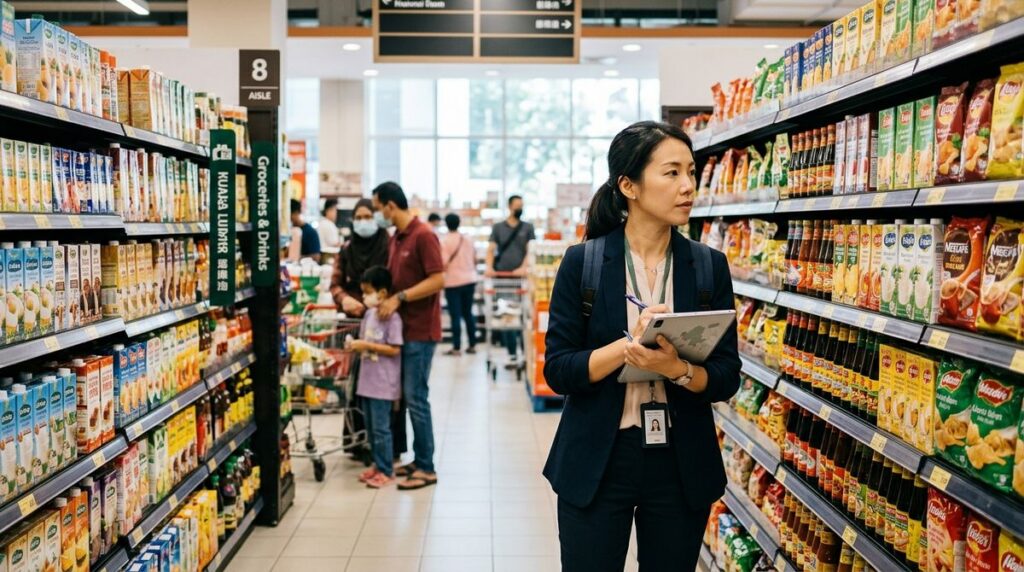
Malaysia’s FMCG market is one of Southeast Asia’s most accessible consumer economies, but brands that enter without a clear strategy routinely discover that strong domestic demand does not automatically translate into sustainable margin. Here is the framework we use to help brand owners enter the Malaysia FMCG market the smart way.
Why Malaysia’s FMCG market rewards the right entry strategy
Retail sales grew 4.9% year-on-year in August 2025, domestic consumption accounts for 61% of GDP, and the economy expanded 4.4% in the first half of 2025. Unemployment sits at 3%, with job creation outpacing labour force growth. For FMCG brands, that combination of stable employment and rising retail footprints signals genuine opportunity.
The catch is margin pressure. SST expansion, electricity tariff hikes, and minimum wage increases are flowing downstream from retailers to suppliers. Brands that enter without modelling these cost pass-through scenarios discover the problem only after trade terms are signed.
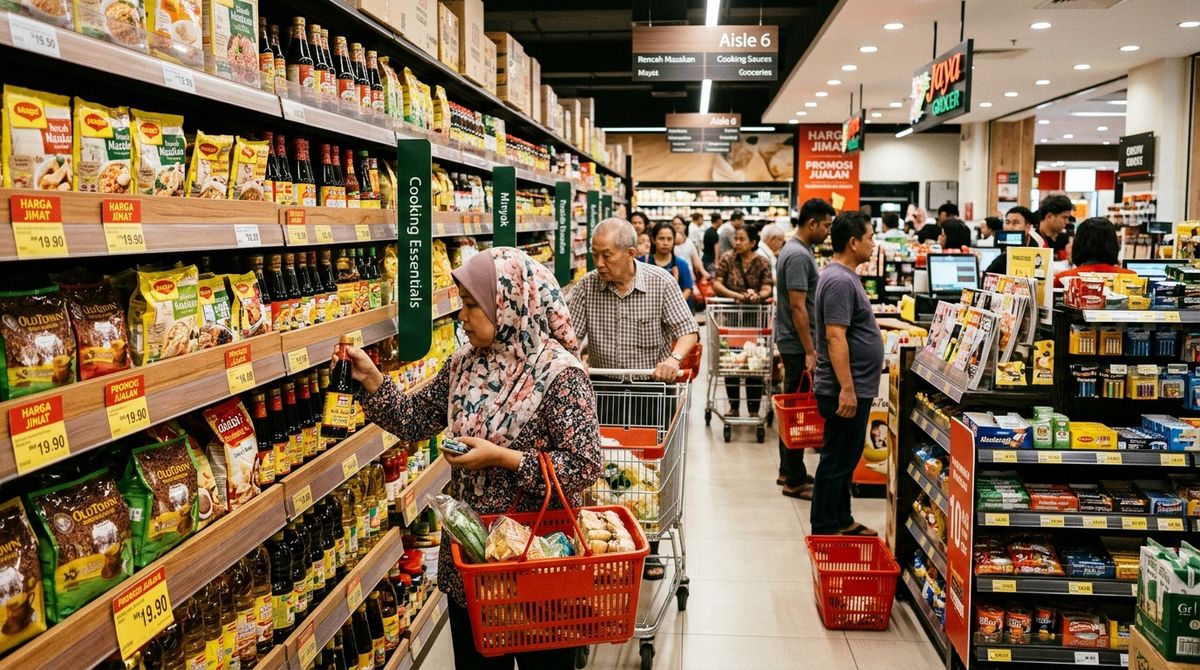
Four phases of a smart market entry
The four phases below form the backbone of a disciplined entry plan: read the market, choose the right distribution partner, price for a cost-sensitive consumer, and execute at store level. Each phase builds on the previous one.
Phase one, read the market before committing capital
Before signing a distributor agreement or committing listing fees, map the retail landscape. Malaysia’s grocery and personal care channels are more fragmented than they appear. Modern trade (hypermarkets, supermarkets, pharmacies such as Guardian and Watsons) is visible but not always the right first channel. General trade, which covers provision shops (small independent grocery stores common in residential areas), mini markets, and Chinese medical halls, often delivers faster velocity for new entrants at lower cost of entry.
Retail expansion among key chains is aggressive. 99 Speed Mart grew from 2,778 stores at end-2024 to 2,894 stores by the second quarter of 2025, with a target of 3,000 by year-end. Eco-Shop is targeting 462 outlets. Map retail density in the Klang Valley (greater Kuala Lumpur and Selangor) first, then Pahang and other states, before deciding which channels to prioritise. That mapping exercise informs which type of distribution partner makes commercial sense.
Phase two, choose the right distribution partner
The distributor decision sets the ceiling on time-to-first-revenue. A partner with the right retailer relationships and channel coverage compresses the launch timeline. A poor fit extends it by months and creates switching costs that are genuinely painful: re-negotiating retailer contracts, reprinting POS materials, and rebuilding relationships that the outgoing distributor owned.
When auditing a prospective partner, look at four things: channel coverage (which retailers they call on and how frequently), cold-chain capability if the product requires it, the quality of sales reporting, and evidence of active merchandising rather than passive order-taking. Understanding what a distributor actually does day-to-day, beyond moving stock, is the starting point for a productive audit.
Phase three, price for a cost-sensitive consumer
Core CPI at 2.0% year-on-year means Malaysian consumers are price-aware even in a stable employment environment. The entry posture for most new brands is value-led: a price point that competes on perceived value within the staples or near-staples segment, not a premium anchor that relies on brand equity the market has not yet granted.
Build a price architecture with at least two scenarios: one that holds volume at current trade terms, and one that absorbs a 5-10% cost increase without destroying the retailer margin that keeps the product ranged.
Phase four, execute at store level
Distribution places the product on shelf. Execution determines whether it stays there. In Malaysia’s general trade, shelf space is contested and informal. Without active merchandising and promotional compliance monitoring, a brand can lose facing within weeks of a successful launch.
The data feedback loop matters as much as the physical presence. Weekly sell-out data by outlet, broken down by SKU, is the minimum required to identify underperforming doors before they become ranging decisions.
The cost pressures that compress margins at entry
This is what most market-entry plans miss. 99 Speed Mart’s OPEX growth accelerated from 9.8% at end-2024 to 12.5% in the first quarter of 2025, then to 17.5% in the second quarter. Retailers absorbing that cost pressure negotiate harder on supplier terms. SST expansion and electricity tariff increases compound the effect.
The recommendation is to build cost pass-through scenarios into the entry plan before agreeing on trade terms, not after. Brands that model this upfront retain negotiating room. Those that discover it mid-contract do not. Conducting thorough due diligence on a prospective distributor includes reviewing how they handle cost volatility with their existing principals.
Which categories have the structural tailwind
Around 60% of Malaysia’s consumer sector is classified as consumer staples. Essentials outperform discretionary in a cost-sensitive environment because purchasing decisions are inelastic. The categories with the strongest structural tailwind for new entrants are personal care, home care, baby care, health and wellness, food and beverage, and pet care.
The government’s RM100 cash handout to all Malaysians, expiring at end-December 2025, is a near-term volume catalyst for mass-market channels. 99 Speed Mart is the clearest beneficiary. Brands positioned in essentials at accessible price points are well-placed to capture that incremental spend.
The one decision that determines entry speed
Based on what the field data shows, distributor selection is the highest-leverage decision in Malaysia FMCG entry. It sets channel reach, pricing discipline, and time-to-first-revenue in a single choice. Brands that enter with a category-specialist distributor with proven retailer relationships reach sustainable volume faster than those that self-distribute or select a partner on price alone.
Lim Soon Huat Group covers 12,000+ retail doors across nine channels, with direct coverage in the Klang Valley and Pahang and managed distributor partners across the rest of Peninsular Malaysia. If the brand is at the stage of evaluating distribution options, our partnerships team is the right starting point. Reach us at /partner-with-us.