
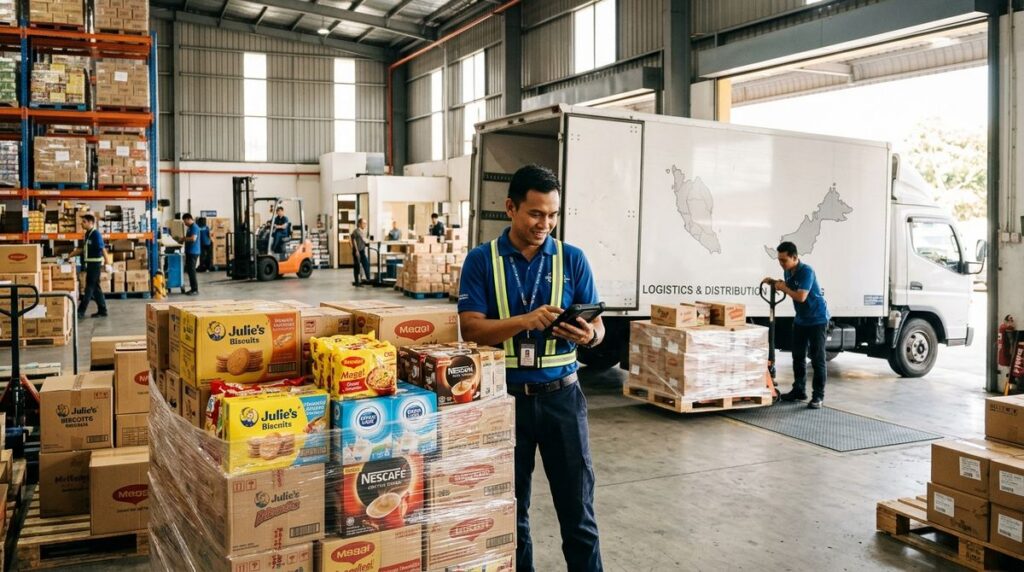
Most foreign FMCG brands entering Malaysia focus on finding a distributor as quickly as possible. That instinct is understandable, but it skips the more important question: what does an FMCG distributor in Malaysia actually do, and what are they responsible for? Getting this wrong costs brands months of lost time and significant money.
The strategic role most brand owners underestimate
The default assumption is that a distributor is a logistics middleman: someone who takes products off a shipping container, puts them in a warehouse, and delivers them to shops. That picture is incomplete, and acting on it leads to poor partner selection.
A well-matched FMCG distributor in Malaysia functions as a market-entry enabler. They determine how fast a brand reaches shelf, which channels it enters first, whether regulatory requirements are met before launch, and how the product is positioned relative to local competitors. For brands entering Malaysia from Australia, Korea, Europe, or elsewhere, the distributor is often the single most consequential commercial decision made in-market.
The stakes are highest for brands in regulated categories: baby food, health supplements, medical nutrition, and certain personal care products. In these segments, the wrong distributor does not simply underperform. They create compliance exposure that can delay or end a market entry altogether.
Five core functions of an FMCG distributor in malaysia
Understanding what a distributor actually does requires moving past the warehousing-and-delivery view. The role spans five distinct functions, each with direct implications for revenue, retailer relationships, and brand equity. The sections below cover each in turn.
Import and physical distribution
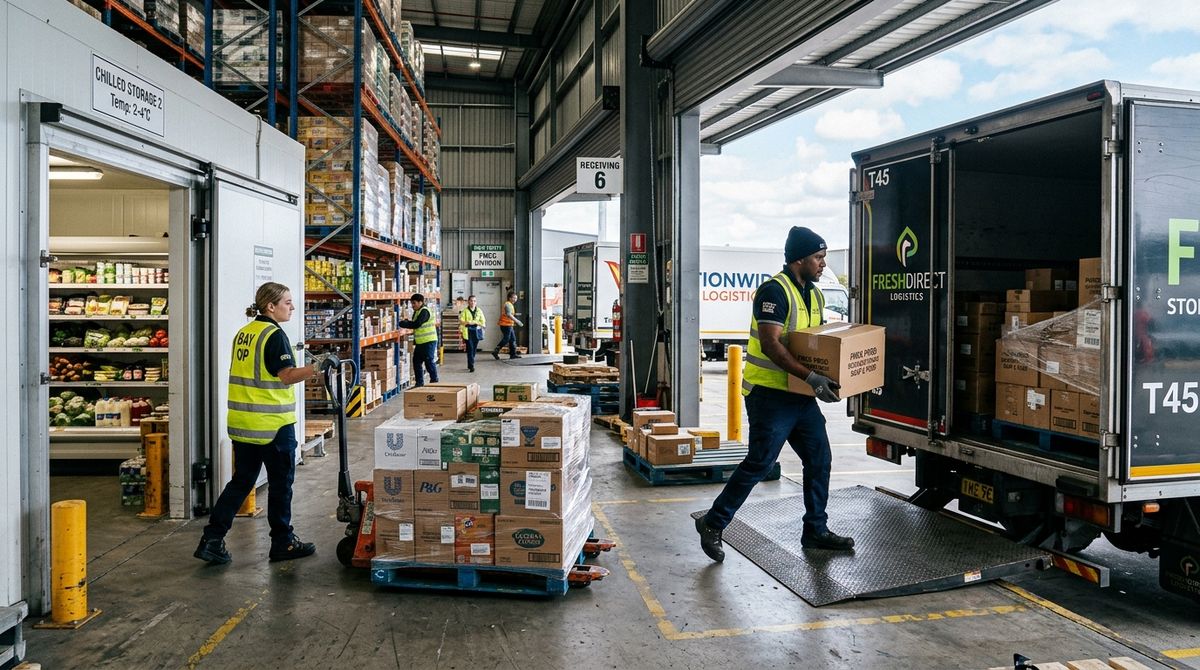
The operational foundation covers customs clearance, bonded warehousing or cold-chain storage, and last-mile delivery across trade channels. In Malaysia, importers must work within the frameworks set by Royal Malaysian Customs, and products entering from non-ASEAN markets often require a licensed importer of record.
Execution quality at this stage has a direct effect on shelf availability. Delayed customs clearance, poor stock rotation, or inadequate cold-chain handling all translate into out-of-stocks and reduced retailer confidence. For context, we operate four distribution centres totalling over 105,000 square feet across Kepong, Sungai Buloh, and Kuantan, with a managed fleet of 30+ trucks covering Central Region and Pahang. Brands that treat this layer as a commodity are often surprised to find that physical distribution is where retailer trust is built or eroded.
Channel access and trade development
Malaysia’s retail landscape is more fragmented than many international brand owners expect. Modern trade includes hypermarkets and supermarkets such as Lotus’s, AEON, and Jaya Grocer; pharmacy chains including Guardian, Watsons, and Caring Pharmacy; and convenience chains such as 99 Speedmart and myNEWS. General trade, which is often underestimated, covers independent mini markets, provision shops (small family-run grocery stores, common in residential and suburban areas), and Chinese medical halls. Baby specialty stores and e-commerce platforms (Shopee and Lazada) round out the picture.
A distributor’s existing buyer relationships determine how fast a brand gets listed, and at what commercial cost. First-time listings in modern trade typically require a formal trading terms negotiation, and in some cases a listing fee. A distributor without a direct buyer relationship at the relevant chain cannot accelerate that process. We cover 12,000+ retail doors across nine channels, which affects both the speed and the cost of getting a brand onto Malaysian shelves.
Regulatory coordination and compliance support
This is the function that most frequently catches foreign brands off-guard. Product registration with the Ministry of Health (KKM) is mandatory for health supplements, medical devices, and certain food categories. Halal certification from JAKIM is not legally required for all products, but it is commercially necessary for the mass market given Malaysia’s Muslim-majority population. Food labelling must comply with the Food Act 1983 and Food Regulations 1985, including Bahasa Malaysia requirements on certain label elements.
Baby food and infant cereals are among the most tightly regulated categories. Regulatory requirements for infant-targeted products include strict documentation, specific health claims restrictions, and additional controls under the Breastmilk Substitutes Act. A distributor who treats compliance as an administrative formality rather than an operational competency is a material risk in these categories. Brands should always verify specific requirements directly with KKM and JAKIM, but the distributor must be capable of working within those requirements from day one.
Market intelligence and commercial validation
A distributor who understands the market provides more than shelf space. Pricing benchmarks, category trend data, competitive shelf analysis, and channel-level feedback are all inputs that reduce expansion risk. The difference between a distributor who can offer this and one who provides only gut-feel assurances is the difference between a structured launch and an expensive experiment.
Based on structured market-entry work covering consumption behaviour, retail trends, pricing dynamics, and category evolution, brands that benchmark Malaysia before committing to a channel strategy consistently make better decisions on pack size, price point, and channel prioritisation. That kind of analysis is what separates brands that launch cleanly from those that spend twelve months adjusting a strategy that should have been validated before the first container arrived.
Sales execution and in-store presence
The distributor’s ground team is the brand’s face at retail. Merchandising, planogram compliance, promotional execution, and field sales coverage all fall within this function. A product that is listed but poorly merchandised, or whose promotions are not executed correctly, loses ROI regardless of how strong the product or brand communication is.
We deploy 80+ sales representatives and 25 merchandisers across our coverage area. For brands unfamiliar with Malaysian retail, the distinction between a coverage call (a sales rep visit to take orders and check stock) and a merchandising call (a dedicated visit to build displays, check facings, and execute promotions) matters significantly. Many distributors offer the former but not the latter, and that gap shows up in sell-through data within the first quarter.
What a distributor is not responsible for
Clarity on scope prevents the most common source of distributor conflict. Brand-building, digital marketing, consumer PR, social media, and product development remain the brand owner’s responsibility. A distributor moves products to shelf and executes trade-level activity. They are not an advertising agency or a brand consultancy.
Misaligned expectations on this boundary are a leading cause of early contract termination. Brand owners who expect a distributor to generate consumer demand independently of brand investment are setting the partnership up to fail. The distributor’s role is to maximise the commercial value of consumer demand that the brand creates. Understanding where distributor responsibility ends and brand responsibility begins is foundational to a productive relationship.

How to assess whether a distributor is the right fit
Three qualifying criteria matter most, and all three must be assessed independently rather than taken at face value from a sales presentation.
Portfolio fit asks whether the distributor already serves the channels and categories relevant to the brand. A distributor strong in pharmacy channels but weak in hypermarkets is not the right partner for a brand targeting mass grocery. Category experience also signals whether the distributor’s sales team can position the product credibly to buyers.
Market coverage asks which regions and trade formats the distributor actually services. Many distributors cover the Klang Valley (the urban and suburban area centred on Kuala Lumpur and Selangor, which accounts for a significant share of Malaysian consumer spending) but have limited presence in East Malaysia or even other Peninsular states like Johor or Penang. Coverage claims in a pitch deck and actual coverage in the field are rarely the same number. Asking for a list of active accounts by state, with delivery frequency, is a reasonable and standard due diligence step.
Execution capability asks what the field data shows about their current brand performance. Distributor references from non-competing brands in similar categories, and a review of their current portfolio, provide more reliable signal than sales promises. A thorough distributor due diligence process will surface gaps that a glossy company profile never will.
The four-phase approach to entering malaysia through a distributor
The sequence of market entry matters as much as the decisions made within each phase. Brands that benchmark first and distribute second consistently achieve faster listings, better margin structures, and lower churn in the partner relationship.
Phase 1: benchmark the market
Before committing resources to Malaysia, compare it against alternative entry markets on consumption behaviour, pricing dynamics, retail structure, category evolution, and regulatory landscape. In an ASEAN market benchmarking project covering Vietnam, Thailand, and Malaysia for a European cereals and baby food company, this phase produced a 15-page comparative analysis that informed the final market selection. That kind of structured assessment reduces the risk of entering the wrong market, or entering the right market in the wrong sequence.
Phase 2: define a malaysia-specific go-to-market strategy
Pricing architecture, channel prioritisation, product positioning, and pack-size selection must be adapted to local retail realities. What works in Australia or Korea does not port directly to Malaysian trade. A brand priced for European premium positioning will face a different competitive set in Jaya Grocer versus 99 Speedmart, and those two channels require different pack sizes, price points, and promotional mechanics. A 35-page go-to-market strategy produced as part of the same ASEAN project gave the client a channel-by-channel commercial roadmap before a single product was shipped.
Phase 3: qualify and shortlist distributors
A qualified distributor shortlist is not the output of a Google search or a trade directory listing. It is the result of verifying trade coverage, assessing relevant category experience, reviewing financial standing, and confirming regulatory awareness. The process starts with a long list that is then narrowed by capabilities and portfolio fit. This step is what determines whether the eventual partner can actually do the job, as opposed to simply expressing interest in doing it.
Phase 4: validate through direct B2B engagement
Structured meetings with shortlisted distributors, typically five to eight targeted conversations at this stage, surface operational fit and commercial intent before a contract is signed. Five targeted B2B meetings with qualified partners, as part of the same ASEAN project, was what ultimately validated the client’s chosen partner before expansion. This step is what separates brands that launch cleanly from those that spend twelve months correcting the wrong partnership.
Why regulated FMCG categories demand a higher standard of distributor
Baby food, health supplements, medical nutrition, and certain personal care products carry documentation, labelling, and certification requirements that most general-trade distributors cannot handle. A brand holding FDA, FSSC, or equivalent international certifications still needs to meet Malaysian-specific regulatory requirements, and the distributor must understand those requirements well enough to support the registration and compliance process.
For brands in these categories, regulatory capability is a hard qualifying criterion, not a secondary consideration. A distributor who is strong on sales coverage but weak on documentation handling creates compliance exposure that can freeze stock at customs or trigger a product recall. The recommendation is to treat this capability on equal footing with trade coverage and channel relationships when assessing potential partners. For category-specific guidance, brands should consult directly with KKM, NPRA, or JAKIM depending on the product type.
Start with the market, then find the distributor
The sequence matters. Brands that benchmark Malaysia, define a channel strategy, and qualify partners before signing a distribution agreement consistently achieve faster listings and better commercial outcomes than brands that begin with a distributor search. Knowing what to look for before appointing a partner reduces the risk of a costly reset twelve months into a market entry.
The FMCG distributor in Malaysia is not simply a route-to-market vendor. At its best, the right partner functions as a commercial bridge between a foreign brand and the Malaysian shopper, handling import, compliance, channel access, and in-store execution in a market that rewards preparation and local knowledge.
If the brand is at the stage of identifying the right partner structure for Malaysia, our partnerships team is the right starting point. Reach out at /partner-with-us to begin the conversation.