

Do you need a distributor in Malaysia? For most FMCG brands selling into general trade, yes. For brands with a handful of modern trade buyers or an online-only launch, no. Route to market sets your landed cost, your speed to shelf and who controls the brand for years, so it needs a decision framework, not a default.
Key takeaways
- A distributor fits general trade reach, regulated or halal-sensitive products with no local licence holder, and brands with no in-country credit and logistics capability.
- Skip the distributor for concentrated modern trade or online-only launches.
- Four variables decide the route: product type, target channel, budget and capacity, and desired control.
- Pilot first. Set performance targets before granting exclusivity.
The short answer: when a distributor is needed in malaysia and when it is not
A route-to-market decision fixes your price structure, your time to first shelf and who owns the retailer relationship. Changing it later costs months of sales and often a contract dispute.
A distributor is the right route when you need general trade reach, when your product needs a local licence holder (regulated personal care, supplements, halal-sensitive food), or when you have no in-country credit control and logistics. It is the wrong route when your sales depend on a few concentrated modern trade buyers or when you launch online only. The trade.gov country guide reports that most exporters find a local distributor or agent the most effective first step. That matches what we see for first-time entrants, though it is a starting point, not a rule.
Four variables settle the question: product type, target channel and outlet count, budget and in-house capacity, and the control you want to keep.
How malaysian distribution is structured
Channel structure decides the route, not national averages. Malaysia’s retail market is valued at USD 132.28 billion in 2026, and food, beverage and tobacco held 57.39% of retail share in 2025. Private consumption is about 61% of GDP, and essentials stay resilient when discretionary spending tightens.
Those numbers show scale, not opportunity. Tapio’s 2026 briefing makes the point directly: aggregate indicators cannot establish product fit, willingness to buy or partner performance. Size your market from customer segments, pricing and routes to market, then test the partner separately.
Modern trade: few buyers, central buying
Modern trade (MT) means supermarkets, hypermarkets, convenience stores, minimarket chains and pharmacy chains such as Watsons and Guardian. A long-serving FMCG practitioner writing in 2020 defines MT as outlets with a proper buying system and a headquarters controlling all branches. That is one qualitative source, but it matches how chains operate: buying is central.
Direct engagement with a limited number of buyers is workable. Listing fees, payment terms and promotional calendars still apply, and modern trade is not always the right first channel for a new brand.
General trade: many outlets, relationship-based buying
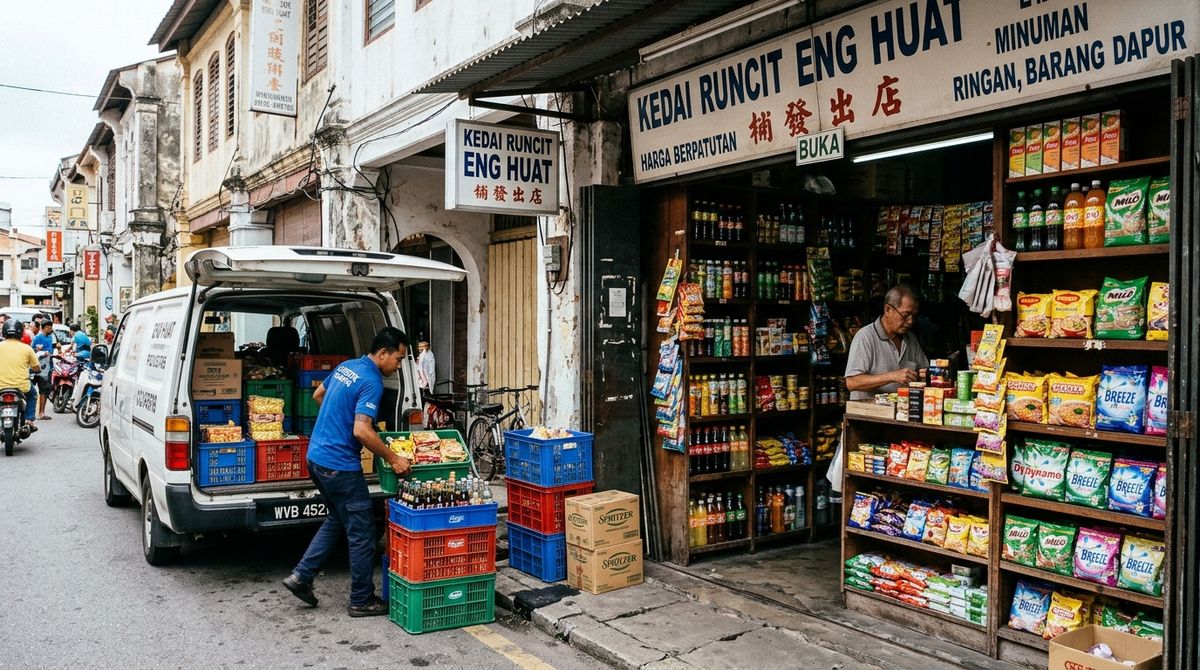
General trade (GT) is the dispersed layer: provision shops (family-run sundry stores), mini markets, independent pharmacies and Chinese medical halls (traditional medicine and health product shops). Statista’s Kantar-based analysis notes that most GT operators are small, family-run businesses buying small quantities of daily essentials. They sit in every city and rural area, while large formats concentrate in urban centres.
These outlets need frequent delivery and credit. Foreign hypermarket expansion is restricted in smaller towns, and smaller-town technology and infrastructure still limit online reach. DuitNow QR, now at over 2.5 million merchant touchpoints, lowers payment friction for small merchants, but it does not replace the van route.
Distributor, agent or importer of record: three roles explained
These three roles get mixed up constantly, and the confusion causes expensive appointments.
A distributor buys your goods, holds inventory and resells to retailers. Asialink Business notes that distributor margins run higher than agent fees because distributors carry inventory, marketing and customer credit costs. An agent represents you, never owns the stock and earns commission. An importer of record is the Malaysian entity named on the import declaration and permits. It can be a distributor, a licensed importer or your own Sdn Bhd (private limited company).
| Distributor | Agent | Importer of record | |
|---|---|---|---|
| Buys the stock | Yes | No | Depends on contract |
| Holds inventory | Yes | No | Often briefly |
| Takes credit risk | Distributor | Principal | Depends on contract |
| Invoices retailers | Distributor | Principal | Rarely |
| Named on permits and registrations | Often | Principal’s local holder | Yes |
Our recommendation: decide which role you need before any partner search begins. The risk split between distributor and principal agent differs sharply, and so does who holds your registrations.
Regulatory triggers that make a local partner or entity practical
Product category decides how much local presence you need. Cosmetics, personal care, supplements and health products fall under the National Pharmaceutical Regulatory Agency (NPRA) under the Ministry of Health (KKM), and notification or registration in practice runs through a Malaysian licence holder. Food and beverage needs JAKIM halal certification where halal status applies. Labels need Bahasa Malaysia. Some goods need import permits.
| Product group | Local licence holder needed in practice? |
|---|---|
| Ambient FMCG (home care, non-regulated) | Importer of record only |
| Regulated personal care and health | Yes, for notification or registration |
| Halal-sensitive food and beverage | Yes, for certification and labelling compliance |
| Chilled or perishable goods | Yes, plus cold chain and permit handling |
Registrations held by a distributor become a control and exit issue. If the distributor holds the NPRA notification or halal certificate, switching partners means re-registering, and your product leaves the market while you do it. Our guide to JAKIM halal certification covers the process in detail.
Requirements change. Verify current rules with NPRA, JAKIM and Royal Malaysian Customs before committing to any structure.
Six alternatives to a distributor, compared
| Route | Holds stock | Carries credit risk | Holds registrations | Upfront cost | Speed | Control |
|---|---|---|---|---|---|---|
| Licensed importer | Importer or you | You | Importer or you | Low | Fast | Medium |
| Commission agent | You | You | You or agent | Low | Medium | Medium-high |
| Own Sdn Bhd | You | You | You | High | Slow | Highest |
| Marketplaces (Shopee, Lazada, TikTok Shop) | You or fulfilment partner | Low | You | Low | Fast | High on brand, low on price |
| Joint venture | Shared | Shared | JV entity | High | Slow | Shared |
| Contract manufacturer | Manufacturer or you | You | You or manufacturer | Medium-high | Slow | High on product, low on channel |
A licensed importer suits ambient products that need customs clearance but little else. A commission agent suits brands that want local relationships while keeping the pricing pen. An own Sdn Bhd fits established exporters with volume to justify a team. Marketplaces suit testing demand. E-commerce is growing from a small base, and the report cited earlier flags margin pressure from regional e-commerce giants. A joint venture fits when a partner brings assets you cannot build. A contract manufacturer suits brands whose cost or registration case improves with local production.
The margin stack: from ex-factory price to shelf price
Every route stacks the same layers: ex-factory price, freight and insurance, import duty, Sales and Service Tax (SST) where applicable, distributor margin, retailer margin, listing and promotional fees, and logistics.
The table below is an illustrative calculation for a 500ml home care product. The figures are assumptions, not market benchmarks.
| Layer (per unit) | RM |
|---|---|
| Ex-factory price | 5.00 |
| Freight and insurance | 0.40 |
| Duty and SST (placeholder) | 0.20 |
| Landed cost | 5.60 |
| Price to distributor | 7.00 |
| Promotional and listing support | 0.30 |
| Price distributor charges retailers | 8.00 |
| Retailer margin (20% of shelf) | 2.00 |
| Shelf price | 10.00 |
The test: if comparable products shelve at RM9.00, the stack must compress by RM1.00, and the distributor’s RM1.00 spread is the first place the question lands. That spread buys outlet reach, delivery and credit management. Direct selling is cheaper only if you deliver those functions for less than RM1.00 a unit, which is rare at small volume. This is a revenue and ROI question, not a margin-minimising exercise. Check duty and SST treatment for your product with Royal Malaysian Customs.

Four variables that decide the route
Score your brand on four variables. The route follows.
Product type
Regulated and halal-sensitive products push toward a local licence holder, because registration and certification need a Malaysian party. Chilled products add cold chain. Ambient products give you the most freedom, since the route choice then rests on channel and capacity.
Target channel and outlet count
A few concentrated MT buyers favour direct or agent models. Thousands of GT outlets favour a distributor with its own van routes, because no principal’s shipments reach a provision shop in Kuantan without one.
Regional reach matters. The Klang Valley (Kuala Lumpur and the surrounding Selangor urban belt) is the easiest to cover, and coverage thins in other Peninsular states, Sabah and Sarawak. Ask every candidate which states it serves with its own fleet and which through sub-distributors. As an example of how this looks in practice, our own direct coverage is the Central Region (KL and Selangor) and Pahang, with the rest of Peninsular Malaysia through managed distributor partners. We serve retail channels only, not food service or HoReCa.
Budget and in-house capacity
Direct selling requires credit control, delivery, merchandising and staff. Tapio’s guidance on testing local talent and total employment cost applies here: price the full team before you decide a distributor is too expensive. A principal without these capabilities in country needs a partner.
Desired control
Pricing, brand positioning, customer data and the ability to switch partners all sit on a control dial. Higher control demands higher investment and slower scale.
The rule of thumb: if two or more variables point to dependence (regulated product, thousands of GT outlets, no in-country capacity), appoint a distributor. If control outweighs the rest and you can fund it, build your own.
A staged route by company stage
A small brand testing the market should start with online sales or a non-exclusive trial with one distributor. The goal is evidence of repeat purchase, not volume.
An emerging brand scaling should appoint a regional or channel-specific distributor with performance targets in the contract. Match the partner’s strengths to your channel: a GT specialist for provision shops, a different partner for pharmacy chains.
An established exporter moves to exclusive distribution for a defined territory, or builds its own entity once volume covers the fixed cost of a team.
Run a six-month pilot at every stage. Set three minimum targets before the first shipment: active outlets, repeat-order rate, and on-time delivery and payment. Take the numbers from the distributor’s own route plan, then write them into the agreement.
Worked example: one product, with and without a distributor
Take the 500ml ambient home care product from the margin section. This is a modelled scenario, and every figure is an assumption.
| With distributor | Direct | |
|---|---|---|
| Landed cost per unit | RM5.60 | RM5.60 plus entity and compliance overhead |
| Time to first shelf | About 3 months | About 6 to 9 months (incorporation, hiring) |
| Headcount in Malaysia | 0 to 1 | About 5 (manager, 2 reps, merchandiser, credit and admin) |
| Delivery and credit | Distributor | You or a hired contractor |
| Outlet reach in month six | 1,500 outlets (route-based) | 150 outlets |
| Cash tied up | Stock plus about 30 days’ distributor credit | Stock plus 45 to 60 days’ retailer credit across hundreds of accounts |
The comparison shows that the direct route buys control and the RM1.00 spread, and pays for it with slower reach, more headcount and more cash. For an ambient product sold mainly through general trade, the distributor route reaches more shelves sooner. Direct selling becomes the better answer when volume carries the fixed cost of the team.
Risks of appointing a distributor and how to plan the exit
A poor appointment costs you stalled sales, a locked territory and lost customer data. You pay for a year of weak distribution, then pay again to rebuild it. Plan the exit before you sign.
Contract protections before appointment
Know the three exclusivity terms. Exclusive means only that distributor sells in the territory and you cannot sell there yourself. Sole means one distributor, but you keep direct sales rights. Non-exclusive means you can appoint several.
Write in minimum performance clauses, with a right to convert or terminate on a miss. Split territories: Peninsular Malaysia, Sabah and Sarawak are separate markets in practice and can go to separate partners. Limits on resale pricing and non-competes need legal review, and stamp duty applies to the agreement. Our guide to the clauses that matter covers each term. Have a Malaysian lawyer review the final draft.
Unwinding a bad appointment
Work through these before termination:
- Confirm who holds NPRA registrations and halal certificates, and transfer them to your name or your successor’s.
- Secure customer lists and outlet data in the agreement.
- Agree a stock buy-back or recovery price.
- Set a transition period with shared delivery duties.
- Brief the successor before the old partner stops shipping.
Our recommendation
Three situations cover most brands we meet.
A first-time ambient FMCG entrant should appoint a non-exclusive GT-capable distributor for a six-month pilot and keep registrations in its own name. A regulated or halal product needs a local licence holder from day one, so appoint a distributor with a proven compliance record, written exit rights and registrations assigned to you. An established brand with an underperforming distributor should audit the contract, enforce performance clauses and consider a dedicated sales and merchandising model such as ALSH for key accounts.
The single next step is to score the four variables, run the pilot and set performance targets before signing exclusivity. If you want to compare routes for your product, talk to our partnerships team at /partner-with-us.