
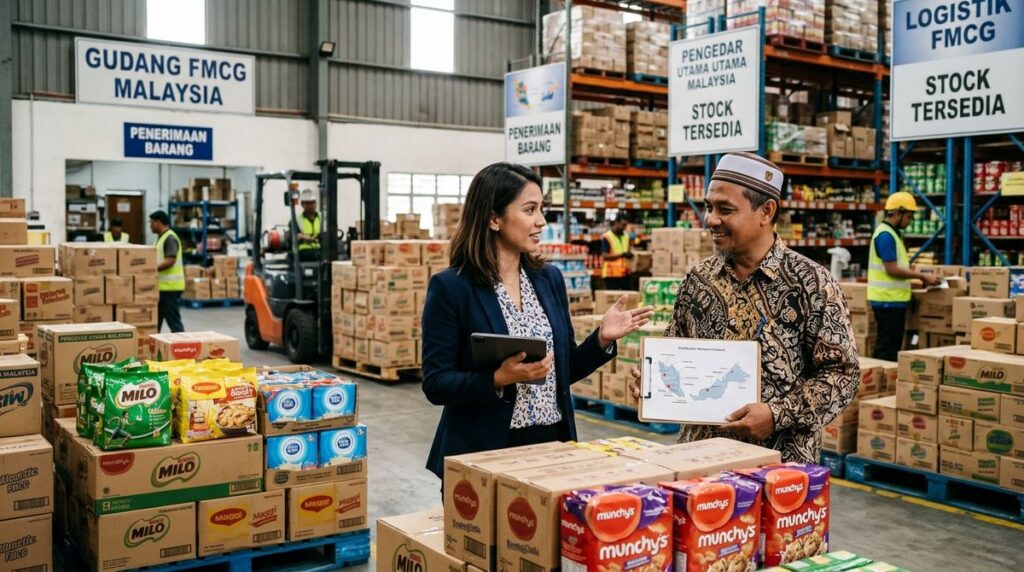
Do you need an FMCG distributor in Malaysia? For modern trade chains, not always. For the thousands of provision shops and mini markets that make up general trade, yes. We built this answer from Malaysian channel data and our own field observation, so you can decide before you commit working capital.
Key takeaways
- Chains such as supermarkets and convenience groups can be served directly through key-account listings.
- General trade (family-run shops, mini markets, rural outlets) needs distributor or wholesaler coverage to be served profitably.
- Choose by order size, SKU range and delivery frequency. Compare quotes on landed cost per unit, not headline price.
- Tie any exclusivity to performance targets, and vet the distributor before signing.
Distributors decide reach, not market entry
The wrong channel decision costs a new brand shelf presence and working capital. In our experience, that loss runs to 12 to 24 months before the brand corrects course.
The decision rule is simple. If your demand is concentrated in a few urban chains, go direct. If your growth depends on reaching independent outlets across towns and states, appoint a distributor. Nothing published tests this question head-on, so treat this as an advisory framework rather than a statistic.
How FMCG reaches the shelf in malaysia
Most brands misjudge this structure, so we start here.
The two-speed channel structure
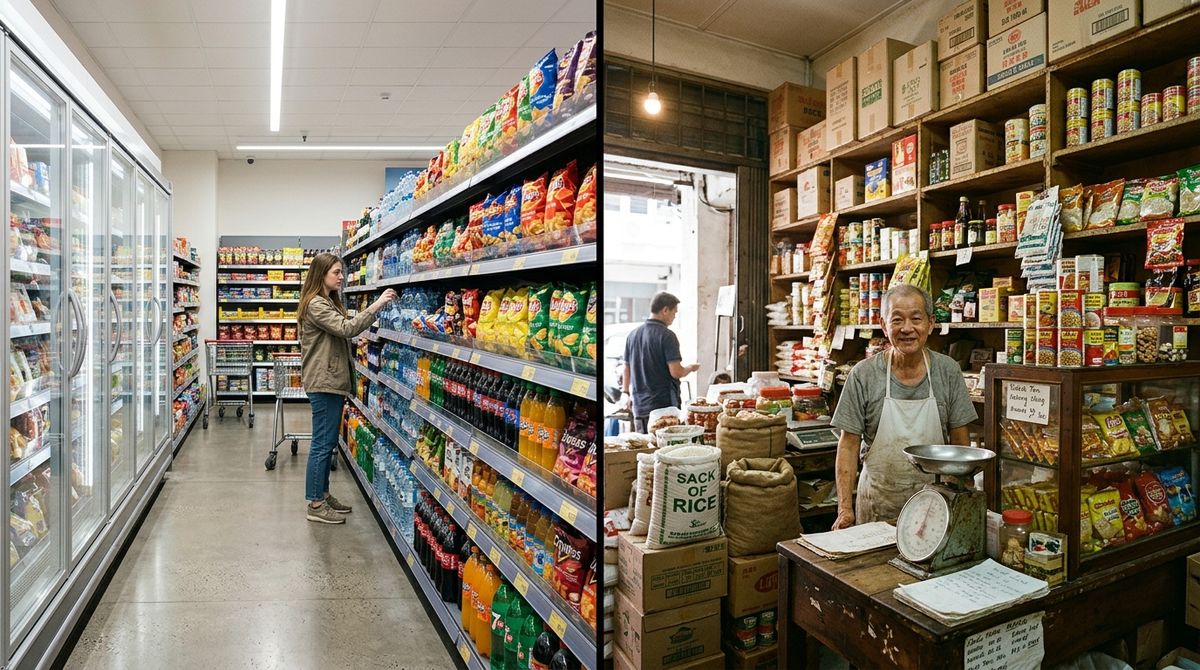
Malaysia runs two retail systems side by side. Modern trade means supermarkets, hypermarkets and convenience chains, concentrated in cities. General trade means family-run provision shops (kedai runcit), mini markets, Chinese medical halls and wet-market stalls, found in every town and village. Modern versus traditional trade behaves differently on pricing, payment and ordering.
The numbers show both speeds. Peninsular Malaysia holds 84.1% of retail market share, concentrated around the Klang Valley (Kuala Lumpur and surrounding Selangor), Johor Bahru and Greater Penang. 99 Speedmart reached 3,037 outlets by December 2025, and non-specialised stores such as grocers and mini markets grew 7.0% in 2025.
Statista’s indicative channel shares put supermarkets at roughly 30 to 34%, hypermarkets at 9 to 10% and mini markets at 4 to 5%. Treat these as directional only. Government restrictions on new foreign hypermarkets in smaller towns also keep traditional stores strong outside cities.
The five layers of the supply chain
| Layer | Role | Who approaches it |
|---|---|---|
| Principal / brand owner | Owns the brand and sets price and strategy | Importers and distributors seeking a brand |
| Sole or authorised distributor | Holds the appointment for a territory or channel | Brands entering Malaysia |
| Sub-distributor | Serves a region or channel under the distributor | Distributors extending reach |
| Wholesaler | Sells in volume to small retailers, often cash-and-carry | Small shops, cafés, online sellers |
| Retailer | Sells to the shopper | Wholesalers and distributors |
A new brand starts at the distributor layer. A kedai runcit or café owner starts at the wholesaler.
When a brand can sell without a distributor
Direct routes are legitimate. Key-account listings with modern trade chains, marketplaces and e-commerce, a small in-house sales team, and cash-and-carry wholesalers all work.
Direct works under three conditions: demand is concentrated in a few urban areas, the SKU range is limited, and your team can handle collections. It breaks down on delivery frequency, credit exposure and the cost of serving many small accounts.
Chains are different from independents because of purchasing scale. 99 Speedmart’s large unified orders narrow the gap between wholesale and shelf prices, so one chain order replaces hundreds of small ones. Independents cannot match that, and a brand cannot serve them one drop at a time. Our guide on selling direct to Malaysian retailers covers the direct route in more depth.
Four drivers that make a distributor necessary
Each driver ties to a business outcome: revenue, working capital or time-to-shelf.
Driver 1: reach into general trade
Revenue depends on outlet count, and a brand’s own team cannot visit thousands of small shops profitably. Southeast Asia shows why depth wins. Indofood reaches 150,000+ outlets, and local manufacturers across the region hold over 50% of FMCG value partly because of that depth. This is regional evidence, not a Malaysian figure.
Driver 2: last-mile delivery and frequency
Small retailers hold little stock and order in small, frequent drops. Serving them needs route planning, trucks and merchandisers, spread across many accounts to keep cost per drop low. A brand with a handful of customers cannot achieve that density.
Driver 3: credit, collections and cash flow
Independent retailers face rising wages, rent, electricity and expanded service tax, and margins are squeezed. Payment delays follow. A distributor carries that receivables risk across hundreds of accounts. A new entrant carries it on a single balance sheet.
Driver 4: import, compliance and local market knowledge
Import permits, labelling and halal status shape what can be sold (covered below). Local knowledge matters too. The Allied Market Research report flags counterfeit brands and complex retail execution as real risks in price-sensitive markets.
Choosing between national, regional and cash-and-carry options
A decision matrix by order size, range and delivery frequency
| Factor | National distributor | Regional / local distributor | Cash-and-carry wholesaler |
|---|---|---|---|
| Minimum volume | Higher | Moderate | Low |
| SKU range suited | Broad | Narrow to moderate | Fast movers |
| Delivery frequency | Scheduled routes | Scheduled, local | Customer collects |
| Credit offered | Structured terms | Varies | Mostly cash |
| Data and reporting | Strongest | Varies | Minimal |
| Typical brand fit | Multi-region launch | One-state focus | Test market |
Worked example: three brands, three routes
These are illustrative scenarios, not client cases.
A 6-SKU imported snack brand wants fast, low-risk testing. Cash-and-carry wholesalers plus a Klang Valley regional distributor fit, because volumes are small.
A 40-SKU household care line needs range depth, frequent drops and credit support. A national or broad-line distributor fits, because the range only pays off with route coverage.
A single-SKU premium baby product sells through pharmacies and baby stores. Key accounts plus a specialist regional distributor fit, because breadth adds little.
How distributors make money and where the margin sits
We cannot quote verified industry margins here. Insert real numbers from your own quotes when you apply the framework below.
The margin stack: distributor margin, trade discounts, rebates and promotions
| Layer | What it adds | Usually funded by |
|---|---|---|
| Ex-factory / import price | Brand’s base price | Principal |
| Distributor margin | Covers warehousing, sales team, delivery, credit risk | Built into price |
| Trade discounts and rebates | Volume and payment incentives | Distributor, sometimes with principal support |
| Promotions and listing fees | Shelf, display, price-offs | Agreed in contract |
| Retailer margin | Shelf price minus buying price | Shopper |
The key negotiating question is who funds promotions and listing fees at each step. Settle it before launch, not after.
Comparing quotes on landed cost per unit
Compare quotes in six steps. Convert carton price to unit price, add freight and delivery charges, check minimum orders, compare payment terms and credit limits, then check return and expiry policy.
Take an illustrative case: 24 units per carton, 10-carton first order.
| Quote A | Quote B | |
|---|---|---|
| Price per carton | RM 46 | RM 48 |
| Delivery | RM 80 per order | Free |
| Payment terms | 14 days | 45 days |
| Landed cost per unit | RM 2.25 | RM 2.00 |
Quote A looks cheaper at RM 46 but costs RM 540 for 240 units, against RM 480 for Quote B. The longer terms on B also protect cash flow.
Halal, labelling and import compliance: who is responsible
Responsibility depends on who holds the import registration and who applies for certification, and the agreement should state both. Verify each requirement with the relevant authority.
On halal, JAKIM certification is the reference point. Ask whether the distributor will apply, or whether your manufacturer must. On labelling, check requirements with the Ministry of Health (KKM). Ask who reviews and corrects labels before stock lands. On import permits, confirm requirements with the Royal Malaysian Customs and, for health and personal care products, KKM and NPRA. Ask which party is importer of record.
Appointing a distributor: exclusivity and the agreement
Exclusive vs non-exclusive appointments
An exclusive appointment gives one distributor sole rights in a territory or channel. A non-exclusive one lets you appoint several.
Exclusivity pays off in a new market where the distributor invests heavily in launch. It traps a brand when the territory underperforms or coverage is narrow. Our recommendation is to tie exclusivity to performance targets, with a right to reduce territory if they are missed.
What the distribution agreement must cover
The clauses that matter in a distribution agreement include:
- Territory and channels
- Sales targets and review periods
- Pricing and price-floor control
- Marketing and promotion funding
- Data reporting
- Stock and expiry handling
- Termination and exit terms
Have a Malaysian lawyer review the final agreement.
How to vet a distributor before signing
This checklist works for new entrants and for principals auditing an existing network:
- Verified outlet coverage by channel and region
- Warehouse and cold-chain visits
- Financial standing
- Service levels (fill rate, delivery time)
- Data quality and sell-out visibility
- Existing brand conflicts
- Reference calls with current principals
- Counterfeit control
Red flags are vague outlet counts, refusal to share sell-out data, direct competitors in the portfolio with no conflict policy, and reluctance to agree performance targets. Established brands should also read the warning signs of a distributor costing you sales.
Coverage beyond the klang valley
Lead times, freight cost and delivery frequency all worsen outside the Klang Valley. Penang and Johor have developed networks. Rural areas have longer routes and fewer drops. East Malaysia is different again: long delivery routes raise landed costs from Peninsular Malaysia to Sabah and Sarawak, so Sabah and Sarawak often need a separate partner.
We run direct coverage in KL, Selangor and Pahang. The rest of Peninsular Malaysia is served through managed distributor partners (see our capabilities). Ask any distributor:
- Which routes do you run with your own trucks?
- Which do you subcontract?
- What is the delivery frequency per area?
- Who answers for stock damage on subcontracted routes?
- How do you report sales from partner territories?
For small buyers: opening a trade account
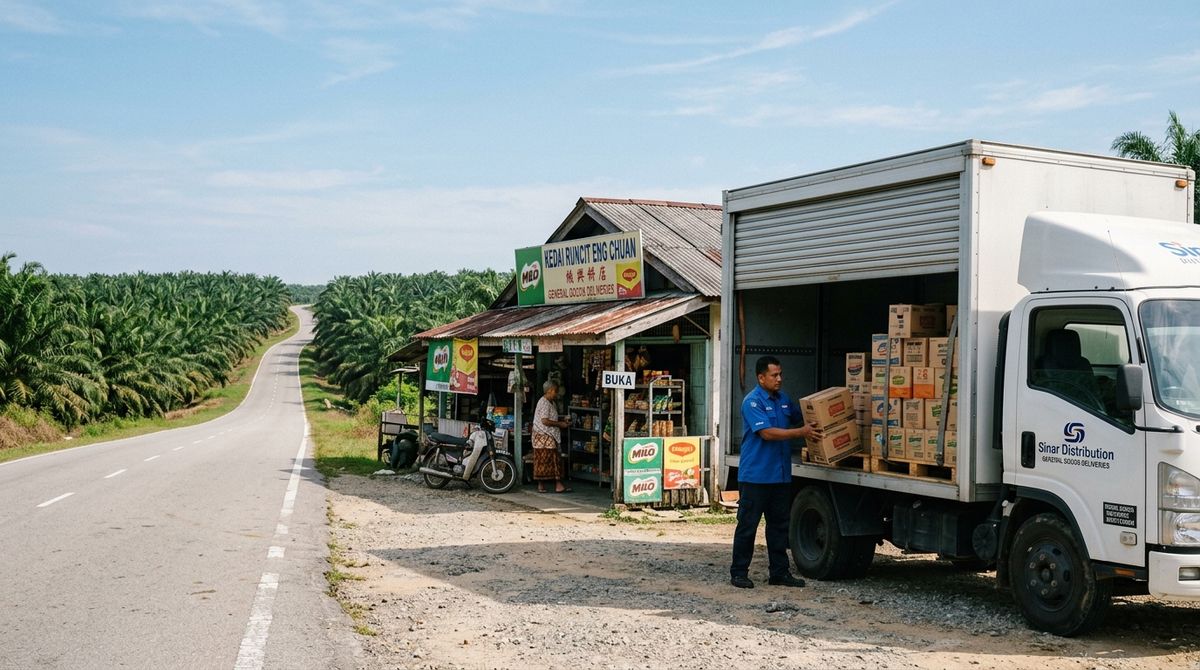
Cash-and-carry wholesalers accept small accounts. Mini markets and provision shops can also open accounts with distributors, though minimum orders apply. Typical documents are SSM registration (the company registry), ID, a deposit and trade references. Start with cash purchases, build a payment record, then ask for credit terms. See our retailer page for how we handle new accounts. We serve retail channels only, so cafés should start with a wholesaler.
Common misconceptions
Does a distributor mean losing control of brand pricing?
No. Price-floor clauses, promotion approval and sell-out reporting keep pricing in the brand’s hands.
Can an online-only brand skip distribution?
Yes, for e-commerce alone. E-commerce has the highest projected channel growth, a 9.3% CAGR through 2031, but a small current share. It does not replace general trade reach.
Can a brand switch distributors without losing its shelf presence?
Yes, with planning. Agree notice periods, stock transfer and retailer account handover in the contract. Retailers buy from whoever supplies reliably, so overlap the handover and keep service continuous.
Our recommendation
Brands with concentrated urban demand and a key-account focus should start direct. Brands that need general trade reach should appoint a distributor on a performance-linked agreement after structured vetting.
- Map your target channels and outlet count.
- Request three quotes and compare landed cost per unit.
- Visit warehouses and call references.
- Agree targets before granting exclusivity.
If you are weighing these options for a Malaysian launch, talk to our partnerships team at /partner-with-us.